


 EN
CN
EN
CN



2026/06/17 3948view
Exciting milestone for our team! Our smart street light solution has been featured in a front-page special report by Fujian Daily—one of the province’s most respected official media outlets.
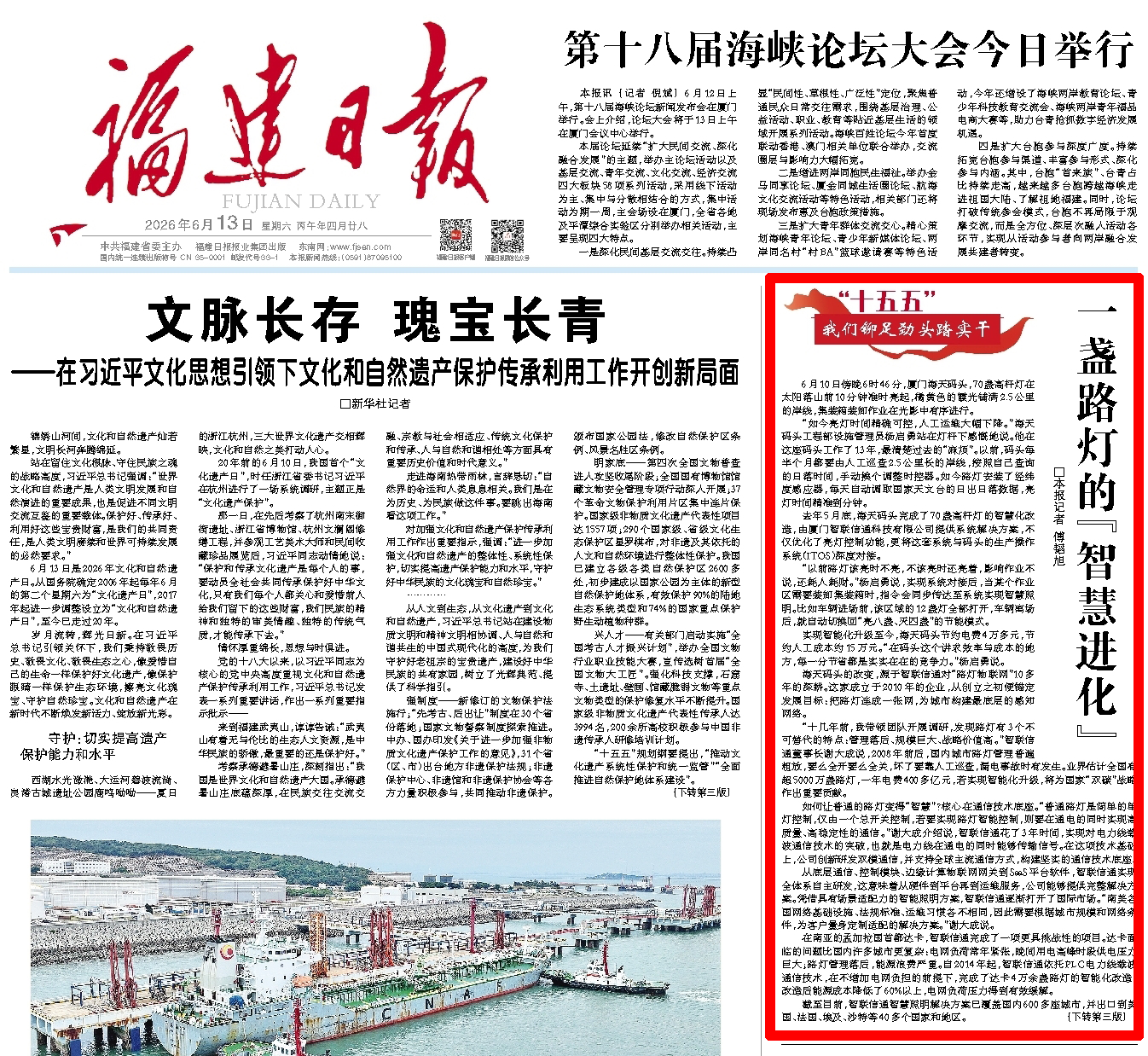
At 6:46 p.m. on June 10th, at the Haishan Port in Xiamen, 70 tall lights were turned on exactly 10 minutes before the sun set. The orange-colored sunlight spread across a 2.5-kilometer stretch of the coastline, and the container loading and unloading operations were carried out orderly under the light and shadow.
"Now the lighting time is precisely controllable, and the manual operation has significantly decreased." Yang Qiyong, the facility administrator of the Ha Tian Wharf Engineering Department, stood under the lamp post and said with emotion. He has been working at this wharf for 13 years and is most familiar with the "troubles" in the past. Previously, the wharf had to be inspected manually along a 2.5-kilometer-long shoreline every half a month. According to the time of sunset they had recorded, they had to manually adjust the time controllers one by one. Now, the streetlights are equipped with latitude and longitude sensors, and they automatically retrieve the sunrise and sunset data from the National Observatory every day. The lighting time is precisely accurate to the minute.
At the end of May last year, Haitian Wharf completed the intelligent transformation of 70 high-pole lights. The system solution was provided by Xiamen Zhilian Xintong Technology Co., Ltd. This not only optimized the lighting control function but also deeply integrated this system with the production operation system (ITOS) of the wharf.
"Previously, the street lights would fail to turn on when they were supposed to, and would keep shining when they weren't supposed to. This not only disrupted work but also consumed a lot of resources." Yang Qiyong said. After the system was integrated, when a certain operation area needed to load and unload containers, the instructions would be simultaneously transmitted to the system to achieve intelligent lighting. For example, before the vehicles entered the area, all 12 lights in that area would be turned on. After the vehicles left, the system would automatically switch to the energy-saving mode of "on eight and off four" to save energy.
Since the implementation of the intelligent upgrade, Haitian Wharf has saved over 40,000 yuan in electricity costs and approximately 150,000 yuan in labor costs. "In a place like the port that emphasizes efficiency and cost control, every penny saved is a real competitive advantage," said Yang Qiyong.
The transformation of Hai Tian Dock originated from IOTCOMM 's 10-year deep exploration of the "Lighting Internet of Things" concept. This company, founded in 2010, set its goal from the very beginning: to connect all the street lamps into a network, to build the most fundamental perception network for the city.
"More than a decade ago, my team and I conducted a research and discovered that street lamps have three indispensable characteristics: backward management, huge scale, and high strategic value," said Xie Dacheng, the chairman of IOTCOMM . Around 2008, the management of street lamps in domestic cities was generally lax. They were either all turned on or all turned off. When they broke down, they had to rely on manual inspections, and power leakage accidents occurred frequently. It is estimated that there are over 50 million street lamps across the country, with annual electricity costs exceeding 40 billion yuan. If they can be upgraded to be intelligent, it will make an important contribution to the country's 'carbon neutrality' strategy.
How can ordinary street lamps become "smart"? The key lies in the communication technology foundation. "Ordinary street lamps are simply controlled by a single light switch, and their operation is solely managed by a main switch. To achieve intelligent control of street lamps, high-quality and stable communication must be realized simultaneously when the power is on." Xie Dacheng explained. IOTCOMM spent three years breaking through the power line carrier communication technology, which enables signals to be transmitted on the power line while it is powered on. Based on this technology, the company innovatively developed dual-mode communication and supported the mainstream communication methods worldwide, thus building a solid communication technology foundation.
From the underlying communication and control module, to the edge computing IoT gateway and the SaaS platform software, IOTCOMM has achieved full independent research and development throughout the entire system. This means that from hardware to the platform and then to the operation and maintenance services, the company can provide a complete solution. With its intelligent lighting solution that is adaptable to various scenarios, IOTCOMM gradually opened up the international market. "The network infrastructure, regulatory standards, and operation and maintenance habits in South American countries are all different. Therefore, solutions that are tailored to the customer's needs and adapted to the city size and network conditions must be provided," said Xie Dacheng.
In Dhaka, the capital of Bangladesh in South Asia, IOTCOMM has completed a more challenging project. The problems faced by Dhaka are more complex than those in many other cities in the country: the power grid is chronically underloaded, and the power supply pressure is extremely high during the evening peak hours; the management of street lights is backward, and energy waste is severe. Since 2014, relying on PLC power line carrier communication technology, IOTCOMM has completed the intelligent transformation of over 40,000 street lights in Dhaka. After the transformation, the energy cost has been reduced by more than 60%, and the pressure on the power grid has been effectively alleviated.
As of now, the intelligent lighting solution provided by IOTCOMM has covered over 600 cities in China, and has also been exported to 40 countries and regions including the United States, France, Egypt and Saudi Arabia.
The outline of the "14-15" plan proposed to accelerate technological innovation in the digital and intelligent field, deepen the expansion of "artificial intelligence +", and empower economic and social development as well as the improvement of governance capabilities. Looking ahead to the "14-15" period, Xie Dacheng has set a new goal: while connecting the streetlights into a network, he also plans to install AI brains on each lamp, so that this network, with the support of AI computing power, can become the core infrastructure of a smart city.
However, he clearly recognized the gap: Currently, AI is deeply integrated with edge algorithms. Although the self-developed algorithm library has accumulated a certain scale, compared with the international leading level, in terms of adaptability to complex algorithmic scenarios, it still needs to continue to catch up.
To address the technical shortcomings, IOTCOMM has been vigorously promoting the research and application of the "All-scenario Self-optimizing Intelligent Edge Digital Foundation" this year. This digital foundation takes the street lamp pole as the core carrier, integrating AI algorithms with core demands such as urban governance, traffic scheduling, and energy optimization. Each lamp is equipped with the ability to learn independently, automatically adjusting the lighting strategy based on factors such as pedestrian and vehicle flow, light intensity, and even the brightness of the moon.
"Light poles are the most densely distributed infrastructure in cities. They have electricity, poles, and communication facilities. Their function is not just for lighting, but also serves as a natural digital node." Xie Dacheng disclosed that the company is exploring new scenarios for the low-altitude economy - drones can be parked on smart light poles to charge and rest, forming a low-altitude network covering the entire city. Currently, small-scale demonstrations are being carried out in some cities, and preparations for pilot verification, standard alignment, and scene implementation have been completed.
The piece, titled "The Smart Evolution of a Street Lamp," dives into how we’re rethinking urban infrastructure. We’ve moved beyond simple illumination to turn street lights into intelligent, IoT-driven sensing terminals that capture real-time city data. It’s not just about brighter nights—it’s about smarter, more responsive cities
To our current and future partners: we’re always open to exploring new ideas. If you’re working on urban transformation projects, let’s connect—we’d love to see how we can collaborate.
 Consult
 Top
Top
 Pre-sales call:
 Xiamen switchboard:
 Email:oversea_sales@iotcomm.com