


 EN
CN
EN
CN



2026/09/02 IOTCOMM Smart Lighting Team 630view
At 2 a.m. on Dabin Road in Dadukou, Chongqing, a single car approaches. The streetlights ahead brighten smoothly as it passes, then dim again once it is gone. It looks like a small miracle — it is actually a smart streetlight retrofit in action.
Fully operational in February 2026, the Dadukou District Streetlight Intelligent Retrofitting and Energy Trusteeship Project is the first large-scale energy-trusteeship benchmark in Chongqing's municipal lighting sector. More than 8,800 streetlights were upgraded, the composite energy-saving rate exceeds 48%, and lighting availability holds steady above 98% — all achieved without a single yuan of public budget.
This article breaks down how the project worked, what was installed, and why the model matters far beyond Chongqing.
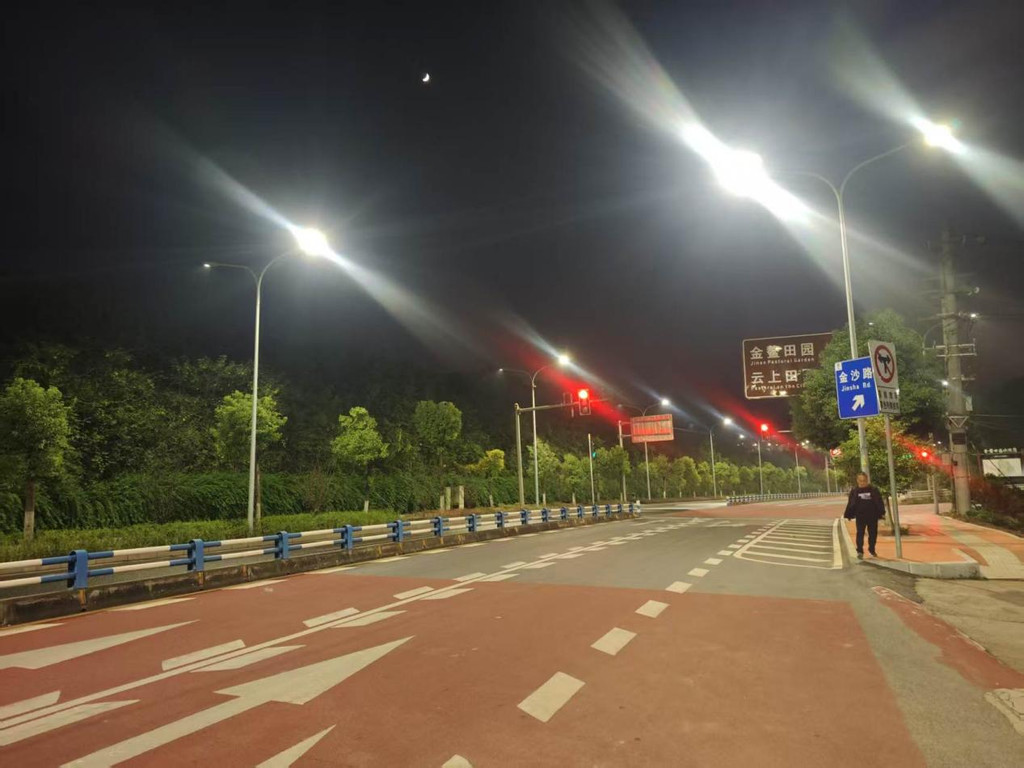
Brightly illuminated Dabin Road in Dadukou, Chongqing after the smart streetlight retrofit, February 2026
Dadukou, a core district of Chongqing, grew around Chongqing Steel — a textbook traditional industrial base. Under the twin pressures of urban renewal and China's dual-carbon strategy, every piece of municipal infrastructure here faces the same challenge: moving from "good enough" to efficient, low-carbon and intelligent.
Streetlights are the most extensive, most decentralized and most citizen-facing asset a city owns. The more than 8,000 fixtures along Dadukou's main roads, secondary roads and branch roads are not only the carriers of nighttime lighting — they are also natural sensing nodes and the most practical entry point into a smart city.
The old way of managing them was painfully familiar across China: energy-hungry high-pressure sodium lamps, coarse one-size-fits-all control, and faults that went unnoticed until a manual inspection patrol found them. Dark streets, dim lamps and delayed fault response were a real part of residents' night-time experience.
This was never a simple "lamp swap". The project runs on an energy-trusteeship mechanism — China's municipal-lighting version of energy performance contracting (EPC).
Under this model, private capital fully funds the replacement equipment, construction and lifecycle operations and maintenance. The government invests nothing upfront. The private operator recovers its investment gradually from the measurable energy savings the retrofit generates — around RMB 20 million (roughly US$2.8 million) of private capital is at work here.
The result is a rare quadruple-win loop: the government reduces its fiscal burden, the investor earns a return, citizens get better lighting, and the city cuts carbon emissions.
The technical work spanned three layers — hardware, sensing and platform:
Single-lamp control at the edge. Nearly 10,000 streetlights were fitted with single-lamp controllers, enabling lamp-level ("one lamp, one policy") management: independent dimming, per-lamp energy metering and precise fault location — no more guessing which fixture on which pole has failed.
Radar sensing so lights can "see". More than 3,000 radar sensor units across the district continuously capture vehicle and pedestrian movement, feeding real-time data into the on-demand lighting logic.
One platform for the whole city. All endpoints connect to a smart lighting management platform: 16,000+ lamps run intelligent single-lamp control with live status monitoring, and 20,000+ lamps are centrally managed remotely — spanning 150+ distribution cabinets and 1,400+ power supply circuits. Together they form an integrated "sense–decide–execute" lighting system.
Four capabilities define the system's day-to-day behavior:
Radar-adaptive lighting. When a vehicle or pedestrian approaches, the lights ahead brighten smoothly; after they pass, the lights dim back. Wasteful all-night burning is eliminated at the source.
One lamp, one policy. Each controller adjusts switching and output power according to sunrise/sunset times calculated from local longitude and latitude, plus real-time ambient illuminance. In the deep night, when traffic thins, lamps automatically run at reduced power — maximum energy saving without compromising safety.
One screen across the district. The platform presents the entire district's lighting status on a single map. It collects more than ten operating parameters in real time — voltage, current, power, cable temperature and more — triggering automatic fault alerts and enabling remote one-click handling. Maintenance shifts from "patrolling the whole city" to "managing from one dashboard".
Flood-safe electrical protection. For flood-prone areas and aging cable zones, intelligent power-protection technology keeps lamps shock-free even when submerged and prevents ground faults from igniting. In heavy rain, a streetlight becomes a safety node, not a hazard.
Dimension | Before | After |
Energy | Sodium lamps at fixed output all night | 48%+ composite energy saving via on-demand, time-scheduled dimming |
Operations | Manual patrols; faults discovered late | 98%+ lighting availability; remote switch, dim and fault-locate from one platform |
Public finance | Full retrofit cost borne by the government | Zero public budget; ~RMB 20M private capital repaid from energy savings |
Safety | Flood risk and aging cables a concern | Immersion-safe, ground-fault-protected lighting; better night-time uniformity |
Beyond the numbers, the change residents feel is real: brighter, more even streets at night, and lighting that stays reliable even in extreme weather.
The Dadukou project validates that "energy trusteeship + smart enablement" works at municipal scale — and offers other cities a practical, replicable template for digital, long-term lighting operations.
For old industrial cities, it proves a crucial point: urban renewal does not have to depend on massive fiscal injection. Bringing in private capital and repaying it through energy savings is a sustainable path.
For carbon-neutrality agendas, it offers a working example from the municipal lighting sector — the shift from coarse control to lamp-level policy is, in miniature, what refined urban governance looks like.
Streetlights are evolving from lighting tools into the digital infrastructure of cities. When every lamp can think, the city gains a little more intelligence.
This case study is published by IOTCOMM supplier of the single-lamp controllers and smart lighting management platform behind the Dadukou retrofit. IOTCOMM smart lighting solutions are deployed in 600+ cities across China and 40+ countries and regions, managing over 4,000,000 streetlights.
If you are looking to reduce energy costs, improve grid stability, or modernize urban operations, our team is here to help. Contact us to discuss your smart lighting project.
Data source: Dadukou District Government (Chongqing) departmental updates and official media reports, August 2026; project commissioning data, February 2026.
A form of energy performance contracting in municipal lighting: private capital fully funds equipment, construction and long-term O&M; the government invests nothing upfront; the operator recovers investment from measured energy savings.
In the Dadukou, Chongqing project — 8,800+ upgraded streetlights — the composite energy-saving rate exceeded 48%, combining radar-adaptive lighting, single-lamp dimming and deep-night power reduction.
A device fitted to an individual streetlight enabling independent switching, dimming, energy metering and precise fault reporting — the basis of "one lamp, one policy" management.
Radar sensors detect approaching vehicles and pedestrians; the control system brightens lamps ahead of them and dims them after they pass, cutting wasted nighttime energy.
Yes — under the energy-trusteeship model used in Dadukou, private capital fronts the investment and is repaid through the energy savings the retrofit delivers.
 Consult
 Top
Top
 Pre-sales call:
 Xiamen switchboard:
 Email:oversea_sales@iotcomm.com